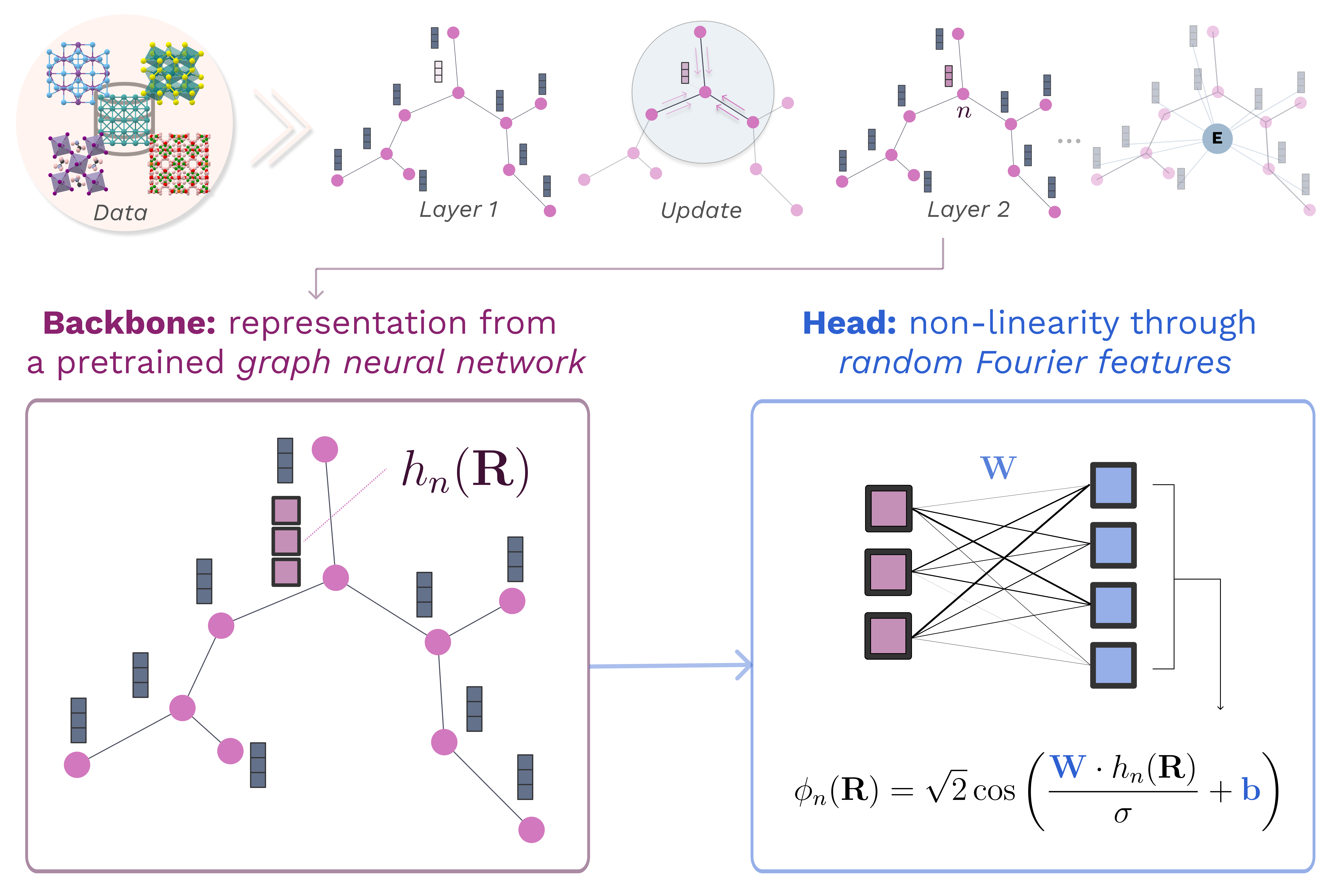
Franken is an open-source library that can be used to enhance the accuracy of atomistic foundation models. It can be used for molecular dynamics simulations, and has a focus on computational efficiency.
franken features include:
Supports fine-tuning for a variety of foundation models (MACE, SevenNet, SchNet)
Automatic hyperparameter tuning simplifies the adaptation procedure, for an out-of-the-box user experience.
Several random-feature approximations to common kernels (e.g. Gaussian, polynomial) are available to flexibly fine-tune any foundation model.
Support for running within LAMMPS molecular dynamics, as well as with ASE.
References
2025
npj Comput. Mater.
Fast and Fourier features for transfer learning of interatomic potentials
Pietro Novelli, Giacomo Meanti, Pedro J. Buigues, Lorenzo Rosasco, Michele Parrinello, Massimiliano Pontil, and Luigi Bonati
Training machine learning interatomic potentials that are both computationally and data-efficient is a key challenge for enabling their routine use in atomistic simulations. To this effect, we introduce , a scalable and lightweight transfer learning framework that extracts atomic descriptors from pre-trained graph neural networks and transfers them to new systems using random Fourier features — an efficient and scalable approximation of kernel methods. It also provides a closed-form fine-tuning strategy for general-purpose potentials such as MACE-MP0, enabling fast and accurate adaptation to new systems or levels of quantum mechanical theory with minimal hyperparameter tuning. On a benchmark dataset of 27 transition metals, outperforms optimized kernel-based methods in both training time and accuracy, reducing model training from tens of hours to minutes on a single GPU. We further demonstrate the framework’s strong data-efficiency by training stable and accurate potentials for bulk water and the Pt(111)/water interface using just tens of training structures. Our open-source implementation ( https://franken.readthedocs.io ) offers a fast and practical solution for training potentials and deploying them for molecular dynamics simulations across diverse systems.
@article{Novelli2025FastPotentials,author={Novelli, Pietro and Meanti, Giacomo and Buigues, Pedro J. and Rosasco, Lorenzo and Parrinello, Michele and Pontil, Massimiliano and Bonati, Luigi},doi={10.1038/s41524-025-01779-z},issn={2057-3960},issue={1},journal={npj Computational Materials},keywords={Condensed,Physical chemistry,Theoretical chemistry,matter physics},month=sep,pages={293},publisher={Nature Publishing Group},title={Fast and Fourier features for transfer learning of interatomic potentials},volume={11},url={https://www.nature.com/articles/s41524-025-01779-z},year={2025},}